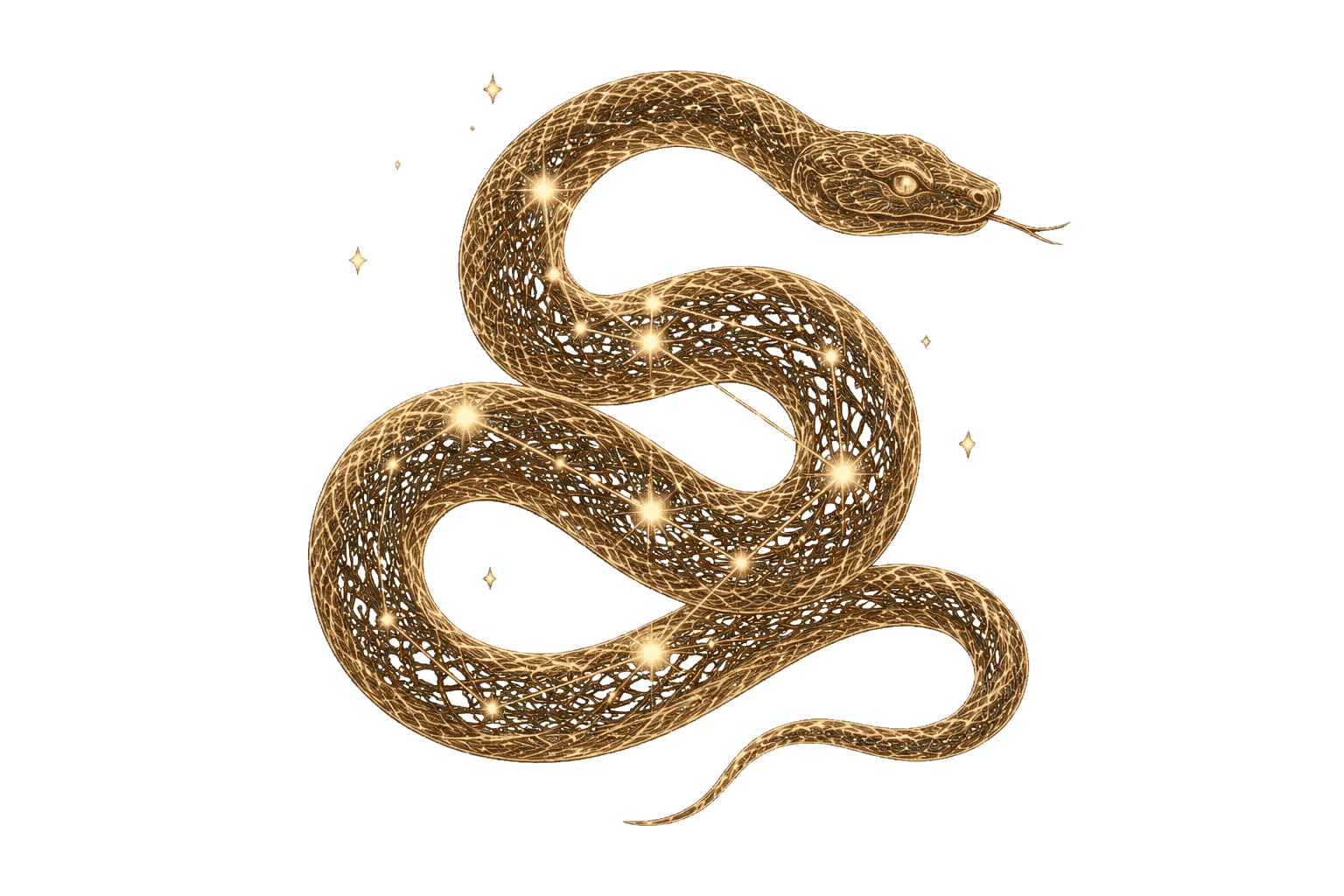




Year of the Snake
Snake Chinese Zodiac Sign: Meaning, Personality & Complete Guide
The Snake (蛇, Shé) is the sixth sign of the Chinese zodiac, traditionally associated with wisdom, intuition, elegance, patience, and thoughtful decision-making. Unlike the often negative symbolism attached to snakes in some cultures, the Snake in Chinese tradition is regarded as a wise, refined figure — representing knowledge and quiet confidence rather than aggression.
People born in a Snake year are traditionally described as observant, analytical, calm, and resourceful, preferring careful reflection before making important decisions. They are often believed to value privacy, lifelong learning, and meaningful relationships over constant attention.
Chinese astrology is a traditional cultural and philosophical system rather than a scientifically established method for predicting personality. The following guide reflects traditional symbolism and cultural belief, explored for reflection and entertainment.
The Legend of the Snake
In the traditional story of the Great Race, the Snake recognized it could never outrun faster animals like the Horse or Dragon through speed alone.
A quiet strategy
Rather than racing openly, the Snake wrapped itself around the Horse's hoof without being noticed, letting the Horse carry it swiftly toward the finish line.
A well-timed reveal
As they neared the crossing, the Snake suddenly slipped forward, startling the Horse and slipping ahead at the last moment.
Sixth through wisdom
The Snake became the sixth animal of the zodiac, with the Horse following immediately after in seventh place — a victory earned through patience and timing rather than raw speed.
Rather than celebrating trickery, most traditional interpretations emphasize the Snake's intelligence: it recognized its limits, thought strategically, and succeeded through observation and precise timing rather than force.
True wisdom lies in knowing when to wait, and when to act.
蛇 The Snake's ability to shed its skin has long made it a symbol of renewal, transformation, and personal growth in Chinese culture.
What Does the Snake Symbolize?
According to traditional Chinese astrology, the Snake symbolizes wisdom gained through observation — intelligence paired with patience, and calm confidence rather than force.
Symbolically associated with reflection, calmness, patience, and inward energy — Yin and Yang are complementary forces, not opposites of good and bad.
Traditionally linked to passion and inner intensity — the combination of Yin energy and Fire symbolism gives the Snake's calm exterior a quietly determined, perceptive core.
Snake imagery has appeared for centuries in temple artwork, literature, and traditional paintings, where it often symbolizes intelligence, longevity, and transformation — a reputation earned through wisdom rather than physical strength.
Snake Personality Explained
The Snake is traditionally viewed as one of the zodiac's wisest and most perceptive signs, admired for its calm demeanor and its gift for reading situations others miss.
Natural wisdom
Insight, good judgment, and emotional balance — the Snake is traditionally seen as someone who thinks before acting.
Sharp intuition
Reads people and situations quickly, often sensing what others overlook or leave unsaid.
Quiet elegance
Values refinement and grace — drawn to beauty, quality, and a composed, understated presence.
Patience & timing
Prefers to wait for the right moment rather than act impulsively — strategic rather than reactive.
Private nature
Values privacy and meaningful conversation over constant social attention, preferring depth to breadth.
Analytical mind
Enjoys research and problem-solving — naturally drawn to understanding how and why things work.
Self-discipline
Sets goals quietly and works toward them with consistency, rarely needing outside pressure to stay focused.
Strategic thinking
Plans several steps ahead, favoring quality decisions over quick ones.
Adaptability
Transforms with circumstances gracefully — comfortable evolving rather than resisting change.
Traditional Chinese astrology does not generally define the Snake by menace. Its central symbolism is wisdom, transformation, and thoughtful decision-making — the same qualities that won it sixth place in the Great Race.
Snake Strengths
According to tradition, the Snake's greatest symbolic strengths are wisdom, patience, and the ability to make thoughtful, well-timed decisions.
Wisdom
Draws on insight and good judgment — considered by tradition to be the Snake's single greatest strength.
Intuition
Senses underlying truths and reads between the lines, often understanding situations before they fully unfold.
Patience
Willing to wait for the right moment rather than force an outcome — a quiet form of confidence.
Emotional balance
Remains composed under pressure, rarely letting emotion cloud careful judgment.
Independence
Comfortable making decisions alone, trusting personal judgment over outside pressure.
Snake Weaknesses
Like every zodiac sign, the Snake's growth areas are traditionally linked to openness and flexibility — the flip side of its natural caution and self-reliance.
Overthinking
Naturally analytical, the Snake may weigh every angle so carefully that decisions get delayed.
Guarded emotions
A private nature can make emotional openness difficult, even with people the Snake trusts deeply.
Resistance to change
Prefers careful, deliberate decisions, which can make sudden or unexpected change feel uncomfortable.
Caution over risk
Prefers well-researched decisions, which can mean missing fast-moving opportunities that reward quick action.
Snake in Love & Relationships
Traditional Chinese astrology associates the Snake with deep loyalty and quiet devotion in relationships — approaching love thoughtfully rather than impulsively, and valuing depth over spectacle.
An intelligent, trustworthy partner who values meaningful conversation and doesn't rush emotional intimacy.
Careful attention, quiet acts of devotion, and remembering the small details a partner cares about.
Dating a Snake
Reserved and observant — the Snake studies a potential partner carefully before opening up, preferring depth and sincerity to fast-moving romance.
Commitment & conflict
Once committed, the Snake is traditionally viewed as deeply loyal and protective of the relationship. During disagreements, the Snake tends to withdraw and reflect before responding — healthy conflict resolution comes from sharing thoughts openly rather than retreating into silence.
Love at a Glance
Snake Compatibility with the 12 Chinese Zodiac Signs
Traditional Chinese astrology views compatibility as a symbolic reflection of complementary energies rather than a scientific prediction. Healthy relationships depend on communication, trust, and shared effort — not birth year alone.
Snake + Rat
A traditionally challenging pairing — both are cautious and observant, which can lead to more distance than connection without effort.
Snake + Ox
One of the most highly regarded pairings — the Ox's steadiness grounds the Snake's introspection, and both value loyalty and quiet dependability.
Snake + Tiger
A traditionally difficult match — the Tiger's boldness and the Snake's caution can clash without patience on both sides.
Snake + Rabbit
Both value calm, thoughtful communication, creating a relationship built on gentleness and mutual understanding.
Snake + Dragon
A traditionally elegant pairing — the Snake's wisdom and calm complement the Dragon's boldness and vision.
Snake + Snake
Two Snakes share wisdom, patience, and thoughtful communication, though both may benefit from practicing more emotional openness.
Snake + Horse
The Snake's caution and the Horse's spontaneity represent contrasting approaches to life that require real effort to bridge.
Snake + Goat
A traditionally uneven match — the Snake's reserve and the Goat's emotional expressiveness call for extra patience.
Snake + Monkey
A traditionally harmonious pairing — both are intelligent and strategic, appreciating cleverness and wit in a partner.
Snake + Rooster
One of the Snake's strongest traditional matches — the Rooster's precision and the Snake's wisdom create a refined, harmonious partnership.
Snake + Dog
A traditionally challenging pairing — the Dog's directness and the Snake's reserve may require extra effort to understand one another.
Snake + Pig
The Pig's warmth can gently draw out the Snake's guarded side, creating a relationship built on patience and gradual trust.
Traditional Chinese astrology often names the Ox and Rooster as the Snake's strongest matches, with the Dragon and Monkey also considered highly harmonious — pairings built on mutual respect, wisdom, and quiet loyalty.
Snake Career & Money
The Snake is traditionally portrayed as a careful, analytical professional who prefers depth of understanding over quick, surface-level decisions.
Snake at work
Prefers to fully understand a problem before proposing solutions — thorough, precise, and rarely rushed.
Quiet, thoughtful leadership
Leads through expertise and calm judgment rather than visibility — earning trust through consistency.
Independent problem-solver
Comfortable working alone on complex challenges, often preferring depth of focus to constant collaboration.
Careers suited to the Snake
Traditionally associated with careful, disciplined financial planning — patient investing rather than chasing quick returns.
May be so cautious that well-researched opportunities pass by while waiting for more certainty.
Snake Family & Friendship
The Snake is symbolically associated with quiet loyalty and deep care — a devoted presence who shows love through consistency rather than grand gestures.
As a friend
A loyal, discreet friend who offers thoughtful advice and values a small circle of deep connections over many casual ones.
In the family
Values privacy and stability within the household, offering quiet support and wise counsel when it's needed.
As a parent
Encourages independent thinking and calm problem-solving — providing a thoughtful, steady presence for children.
Social life
Prefers meaningful one-on-one conversations to large gatherings, valuing quality of connection over quantity.
Snake Health & Well-Being
Traditional Chinese astrology links the Snake's calm exterior to a need for genuine emotional release, balanced by its natural preference for quiet, restorative routines.
Calm energy
Benefits from low-key, sustainable activity like walking, swimming, or yoga rather than high-intensity chaos.
Sleep & rest
Prone to a busy, analytical mind at night — a consistent wind-down routine supports deeper rest.
Emotional release
Benefits from expressing feelings rather than internalizing them — journaling or trusted conversation can help.
Quiet recovery
Recharges through solitude and calm environments rather than constant social stimulation.
The Five Elements of the Snake
In Chinese astrology, each of the 12 animals cycles through five natural elements — Wood, Fire, Earth, Metal, and Water — creating a complete 60-year calendar cycle. The element adds a symbolic layer to the Snake's core personality.
Wood Snake
Creative, adaptable, and cooperative — open to new ideas while keeping its characteristic caution.
Fire Snake
Passionate, charismatic, and energetic — the boldest and most magnetic expression of this sign.
Earth Snake
Practical, dependable, and balanced — grounds its wisdom in realistic, steady planning.
Metal Snake
Determined, disciplined, and resilient — precise and unwavering once a decision is made.
Water Snake
Insightful, intuitive, and thoughtful — the most reflective and perceptive expression of the sign.
Snake Birth Years
Because the Chinese zodiac follows the lunar calendar, anyone born in January or early February should check the exact Lunar New Year date before confirming their sign.
Myth or Fact?
The Chinese Snake represents danger and deceit.
Unlike some Western traditions, the Snake in Chinese culture is generally viewed as a symbol of wisdom, intelligence, and renewal.
The Snake is secretive because it cannot trust others.
Traditional symbolism more commonly associates the Snake with privacy and thoughtful communication rather than distrust.
Snake people are always quiet.
Many Snake-born individuals are outgoing and expressive depending on their unique experiences and temperament — calmness is a tendency, not a rule.
Frequently Asked Questions About the Year of the Snake
What does the Snake symbolize in Chinese astrology?
Wisdom, intuition, elegance, patience, and thoughtful decision-making.
Why is the Snake sixth in the Chinese zodiac?
According to the legend, the Snake quietly rode on the Horse's hoof across the finish line and slipped ahead at the last moment, becoming sixth while the Horse followed in seventh.
Which years are Years of the Snake?
Recent Snake years include 1929, 1941, 1953, 1965, 1977, 1989, 2001, 2013, and 2025.
Is the Snake lucky in Chinese culture?
Yes — the Snake is traditionally viewed as a symbol of wisdom, renewal, and transformation, thanks in part to its ability to shed its skin.
What element is the Snake associated with?
Fire is the Snake's fixed element, while each birth year also cycles through Wood, Earth, Metal, and Water.
What is the Snake's Yin-Yang classification?
The Snake is classified as Yin, symbolizing reflection, calmness, and inward energy.
Which signs are most compatible with the Snake?
The Ox and Rooster are traditionally considered the Snake's strongest matches, with the Dragon and Monkey also viewed as harmonious.
Which signs are most challenging for the Snake?
The Rat, Tiger, Goat, and Dog are traditionally seen as more challenging pairings, though understanding and communication can bridge most differences.
What are the Snake's greatest strengths?
Wisdom, intuition, patience, strategic thinking, and emotional balance.
What are the Snake's biggest challenges?
Overthinking, emotional guardedness, and resistance to sudden change — growth opportunities rather than fixed flaws.
What careers suit the Snake?
Researcher, physician, psychologist, lawyer, financial analyst, and data scientist, among others.
Is the Snake a good leader?
Yes — the Snake tends to lead through expertise and calm judgment rather than visibility or authority.
Is the Snake good with money?
Traditionally yes — the Snake is associated with careful budgeting, disciplined saving, and patient, well-researched investing.
Is the Snake loyal in relationships?
Yes, deeply loyal and devoted once trust is established, though emotional expression may develop gradually.
Does the Snake fall in love easily?
Not typically — the Snake studies a potential partner carefully before opening up emotionally.
Can two Snakes have a successful relationship?
Yes — Snake-Snake pairings often share wisdom, patience, and thoughtful communication, though both may need to practice more emotional openness.
What animal represents the Snake?
蛇 (Shé), symbolizing wisdom, intuition, and transformation through its ability to shed its skin.
What is the Snake's greatest weakness?
A tendency toward overthinking and emotional guardedness, which can delay decisions or create distance in relationships.
What are the Snake's lucky numbers and colors?
Lucky numbers are traditionally 2, 8, and 9; lucky colors include black, red, and yellow.
Does the Year of the Snake guarantee good luck?
No — traditional astrology offers symbolic themes rather than guarantees; real outcomes depend on effort, choices, and circumstances.
What is the Snake's greatest lesson?
Balancing wisdom with emotional openness, so that careful judgment doesn't come at the cost of genuine connection.